
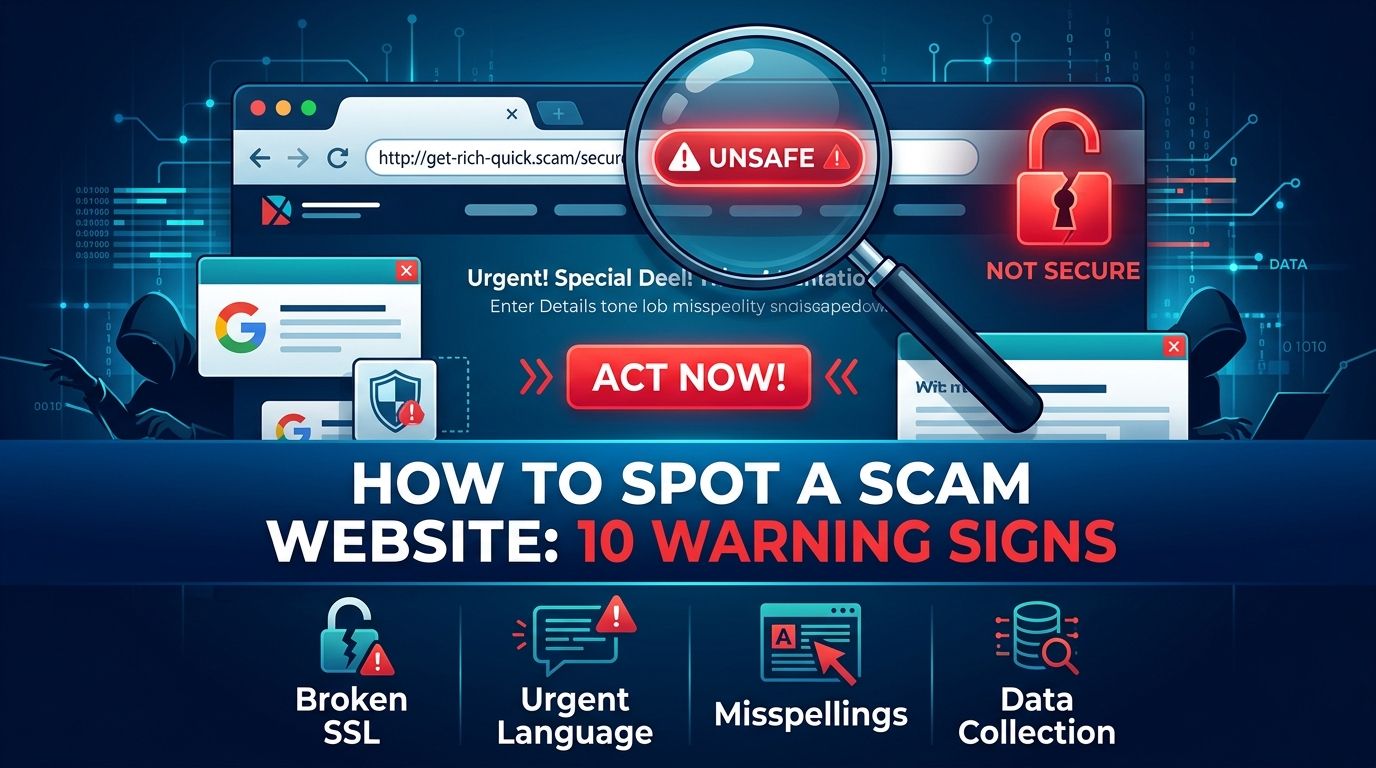
How to Spot a Scam Website: 10 Warning Signs to Check Before You Buy
You need to know how to spot a scam website before you enter your credit card number. Fake online shops look real, but they will steal your cash.
Losing your money to online fraud hurts. These ten quick checks will protect your bank account from fake sellers.
Every day, people lose thousands of dollars on fake stores. This guide shows you how to tell if an online store is legit. You will learn the exact red flags to look for. Use these simple steps on any device.
1. Why is there no padlock in the address bar?
Look at the top of your screen. Safe stores use a lock icon next to their name. This means they lock your payment details.
We call this lock SSL. It acts like a digital shield. It keeps your bank card numbers safe from hackers.
Scammers build cheap sites. They do not buy the security codes that lock your private data. They want to grab your numbers directly.
To check this, look at the website address. It must start with HTTPS, not HTTP. The extra letter means your connection is secure.
Never type your password or credit card on a site without this lock. It is too risky. If the lock is missing, close the tab.
2. Where is the physical address and contact details?
Real businesses want to help you. They put their phone number and physical address on their page.
Thieves do not want you to find them. They hide their real location. They only offer a basic form to email them.
Open their contact page. Look for a phone number. Real shops have people you can call.
Copy their address into an online map. If the address is a random field or a private house, leave.
Sometimes, scammers use a fake address. They copy a real business address to look safe.
Search the address online. See if it belongs to another company. This simple check takes under a minute.
3. Are the prices too low to be real?
A brand-new jacket usually costs two hundred dollars. If a seller offers it for ten dollars, pause.
Fraudsters use cheap prices to grab your attention. They know you want a good deal. They take your cash and ship nothing.
You might get a cheap piece of plastic instead of your item. Or, you might get nothing at all.
Compare the price with official retail stores. Check other sites to see the average cost.
If the discount is over seventy percent on new items, it is probably a trap. Honest businesses cannot afford to sell items that cheap.
Do not let a low price trick your common sense.
4. Why are there spelling mistakes and weird grammar?
Legitimate brands hire professional writers. They proofread their text. Their pages look clean.
Criminals work fast. They copy text from other places. They use automated translation tools that make bad mistakes.
Read the home page carefully. Look for strange capital letters. Check for sentences that sound awkward.
You might see words like "the best buyings" or "fast deliver." These are not professional terms.
Bad spelling is a warning sign. It shows the owner did not spend time or care on their store.
If the text looks sloppy, their customer service will be sloppy too.
5. Are the customer reviews copy-pasted or missing?
Reviews tell you if previous buyers are happy. Fake sites often have no reviews. Or they have reviews that sound exactly alike.
Scammers write fake praise to make their store look popular. They copy reviews from real shops to trick you.
They use fake names and stock photos of people. Sometimes, all reviews have five stars with no details.
Copy a sentence from a review. Paste it into a search engine.
If the exact words show up on ten different shops, they are fake.
You can also check independent review platforms. Search the store name on Trustpilot or the Better Business Bureau. If there are zero reviews there, be careful.
6. Where is the return and refund policy?
Honest shops let you send items back. They write clear rules about refunds. They want to keep you happy.
Thieving sites do not offer returns. They do not want to give your money back. Their return policy page is often empty.
Check the bottom of their page. Read the terms.
Sometimes, they copy a policy from a major store. They forget to change the store name.
If the policy is only one paragraph or sounds vague, do not buy from them.
A real policy details how many days you have to return an item. It lists the address to ship it back.
If these details are missing, your money is gone if the item breaks.
7. Why does the seller ask for gift cards or wire transfers?
Safe stores accept credit cards. They use secure processors. This gives you fraud protection.
Scammers want cash that they can move instantly. They ask for wire transfers, gift cards, or cryptocurrency. These payment methods are like cash.
Once you send the money, it is gone forever. Your bank cannot get it back.
Always walk away if a shop refuses normal credit cards.
They might say their card reader is broken. They might offer a discount if you pay with a gift card.
This is a trap. Legitimate stores never ask you to pay with Amazon or iTunes gift cards.
8. Spot a scam website by its creation date?
Established online stores build their business over years. They own their web address for a long time.
Fraudsters build websites that only stay open for a few weeks. They shut them down when too many people complain.
Use a free domain lookup tool online. Type the store name in.
If the site was created last month, that is a red flag.
You can find free lookup sites by searching "whois lookup." It shows the exact date the owner bought the web address.
Newer sites have higher risk. If a site is under three months old, proceed with extreme caution.
9. Fake or dead social media accounts
Real brands use social media to connect with shoppers. They post updates and talk to customers.
Fake sites have dead links at the bottom. The icons for Facebook or Instagram go nowhere. Or their social pages have no comments. Click the social icons. Check if they have active accounts. If the links just reload the homepage, the owner is hiding. If they do have an Instagram account, look at their posts. Check the comments. If comments are turned off, they are blocking angry victims. Real pages allow customer questions.
10. Are countdown timers forcing you to buy quickly?
Thieves do not want you to think. They want you to act fast before you spot their tricks.
They use flashing timers. They show fake warnings like "only one item left." This pressure stops you from checking their site. Close the tab. Open it again in a new window.
If the timer starts over, the pressure is fake. It is a computer code meant to scare you.
Real stores do not need to rush you. If a seller makes you feel panicked, close the browser. Take a breath. Your safety is worth more than a fast deal.
What to do if you spot a fake website red flag
If you spot a fake website red flag, do not enter your payment info. Do not type your password.
Close the website immediately. Your data might be at risk if you stay.
If you already entered your card number, call your bank. Tell them you gave your card to a fraudulent site.
Ask them to freeze your card. They can stop unauthorized charges before they happen.
You should also change your passwords. If you use the same password on other sites, change those too.
Thieves will try to log into your other accounts.
Finally, report the site. You can file a report with your local fraud agency.
In the United States, use the Federal Trade Commission website. In the United Kingdom, contact Action Fraud. Reporting helps shut these thieves down. It keeps other shoppers safe.
How to tell if an online store is legit instantly
You do not have to guess if a shop is real. You can get instant help.
We built the VastOutlet Threat Rating Engine to protect you. It is a free tool that checks sites in seconds.
Type the web address into our engine. Our tool looks at the security registration and domain age.
It scans for known scam patterns instantly. It gives you a clear safety rating.
This tool takes the guesswork out of online shopping. It shows you fake website red flags before you spend a dime.
Check any website now with the VastOutlet Threat Rating Engine
Keep our engine bookmarked on your phone. Use it every time you try a new store.
Protect your hard-earned cash from online thieves. It only takes ten seconds to run a check.
Safe shopping starts with smart decisions. Let our tool do the heavy lifting for you today.
Worried this happened to you?
Our Threat Rating Engine can analyze suspicious URLs, email addresses, or cryptocurrency wallets associated with potential scams.
Scan suspicious linkarrow_forwardProtecting Your Digital footprint
Once you have identified these threats, taking immediate action is essential. Do not delay banking checks or changing passwords. By locking down your account security policies and setting up credit monitoring blocks, you can completely isolate yourself from modern credential-harvesting networks.