
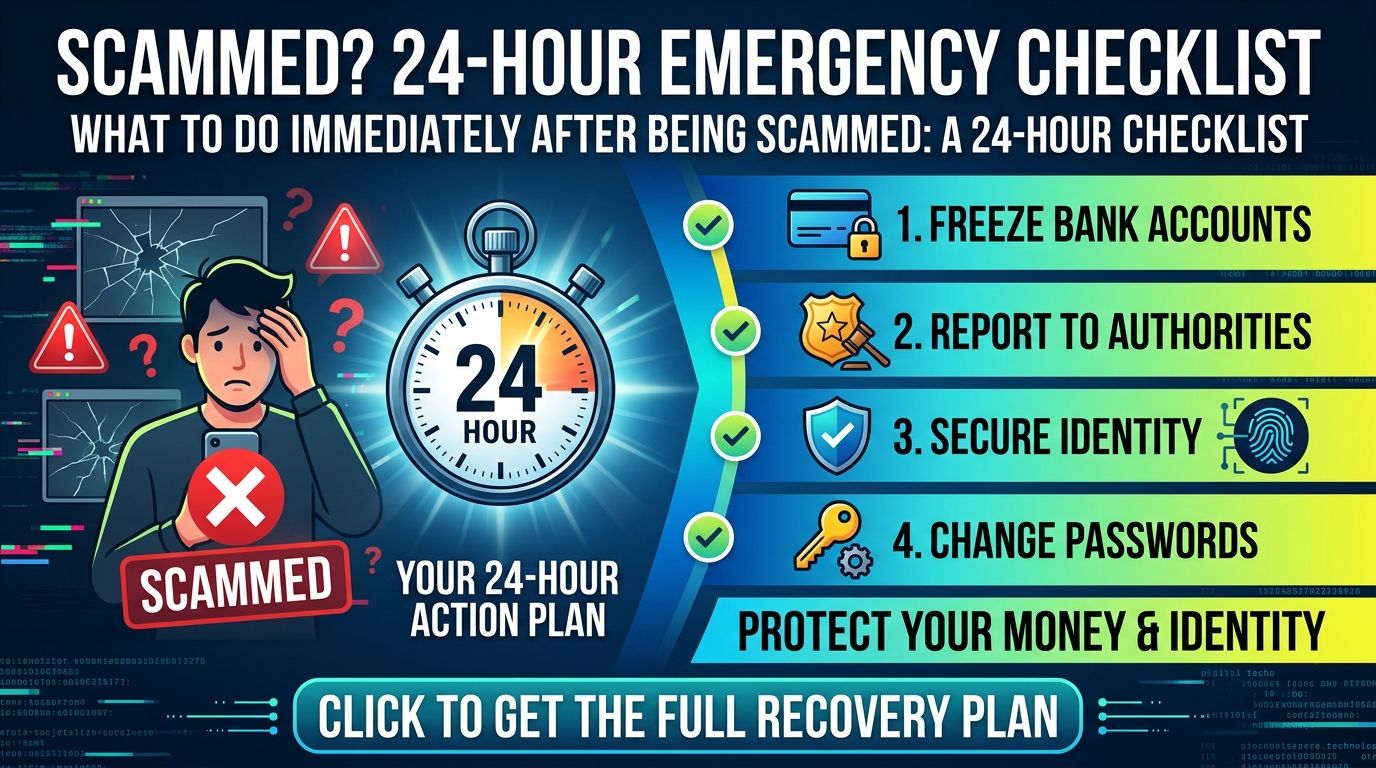
What to Do Immediately After Being Scammed: A 24-Hour Checklist
Learning what to do after being scammed within the first twenty-four hours can prevent further financial damage and protect your identity. Discovering that a criminal tricked you creates instant panic and shock. You do not have to handle this overwhelming situation without a clear plan. Following a structured sequence of actions allows you to regain control over your personal profiles and bank accounts today.
Different types of fraud require fast protective choices to stop ongoing losses. Whether you handed over cash, shared your Social Security number, or gave remote access to your computer, speed matters. Taking direct steps during the first day builds a protective barrier around your remaining assets. Let us examine the exact timeline to secure your personal records and money.
First Hour: What to Do After Being Scammed
Cutting off all communication channels with the scammer is your top priority during the first hour. Block their telephone numbers, email addresses, and social media profiles on your devices immediately. Never confront the thief or demand your assets back through private chat messages. Confronting a criminal alerts them that you discovered the fraud, prompting them to move stolen assets faster.
If you transferred money or shared payment card numbers, contact your bank or payment app right away. Call the official phone number printed on the back of your debit card or checking statement. Ask the representative to connect you directly with the specialized fraud department without delay. Explain that you sent funds to an imposter and need emergency assistance to freeze compromised accounts.
Ask your financial institution to initiate an emergency recall or dispute on the compromised transaction. Request fresh account numbers, payment cards, and online banking credentials sent directly to your home address. If you used instant transfer apps or wire services, report the fraudulent activity immediately to their compliance teams. We cover payment recovery steps in full detail in our dedicated guide on recovering money sent to a scammer.
If you gave a caller remote access to your laptop, disconnect your device from the internet instantly. Unplug your Ethernet cable or turn off your home Wi-Fi connection to block external background access. Uninstall any remote management programs the caller instructed you to download during the conversation. Disconnecting your hardware stops active surveillance scripts from reading your stored passwords or private files.
First Few Hours: Secure What Might Be Compromised
Securing your digital account profiles stops the criminal from accessing secondary personal files or linked payment options. Change the security passwords across all your active accounts, starting with your primary email inbox immediately. Your main email inbox acts as the master key to your entire digital footprint. Create long, unique passphrases for every financial portal using a trusted password management application.
Turn on two-factor authentication across all your critical accounts to block unauthorized logins. Set up a security app on your phone that generates a fresh verification code every thirty seconds. Adding this secondary verification layer stops remote intruders even if they discovered your personal account password earlier. Avoid using text message codes whenever possible because scammers can intercept mobile phone signals through SIM transfers.
Inspect your active banking and shopping portals for unfamiliar charges or altered account details. Look for new shipping addresses, secondary email contacts, or unfamiliar phone numbers added to your profiles. If a thief stole your Social Security number or private identity details, place a credit freeze immediately. Contacting Equifax, Experian, and TransUnion stops lenders from pulling your credit report to approve fake loans.
Placing a credit freeze is completely free under federal law and takes under ten minutes online. Locking your credit files prevents identity thieves from opening unauthorized credit cards under your legal name. You will receive unique security codes from each credit bureau to lift the freeze whenever you apply for credit yourself. Taking this preventive step removes immense worry while you clean up past fraudulent activity.
Within the Day: Document and Report
Gathering complete transaction records while your memory is fresh provides essential support for formal fraud disputes. Open your messaging applications and take clear digital screenshots of every text conversation, email, and social media chat. Capture images of recipient phone numbers, website addresses, email handles, and user profiles. Save transaction receipts, bank confirmation notices, and transfer slips showing exact dates and dollar amounts.
Write a clean, chronological timeline describing every event leading up to the fraudulent interaction today. Record the exact time you first communicated with the scammer alongside the specific claims made to deceive you. Note the exact actions you took, including payment apps used, bank accounts involved, or software packages installed. Storing these digital files and written notes in a dedicated folder prepares you for formal investigations.
Submitting official fraud declarations creates a verified paper trail that strengthens your position with financial institutions. Visit the Federal Trade Commission reporting portal at reportfraud.ftc.gov to file an official government declaration. The interactive portal guides you through detailed questions regarding the compromised accounts, lost funds, and imposter details. Completing this official form generates a formal federal report recognized by major banks and law enforcement agencies.
Visit your local police station to file an official criminal incident report regarding the financial theft. Bring physical copies of your government fraud declaration, photo identification, proof of address, and complete transaction records. Explain to the investigating officer that you need an official crime report number to submit to your bank. Many financial institutions require a verified police report before processing major fraud claims or interbank recall requests.
The Following Days: Monitor and Follow Up
Monitoring your bank accounts and credit reports continuously over the following weeks prevents lingering security surprises. Set up automated account alerts on your mobile phone to notify you whenever charges occur on your cards. Review your checking and savings transactions line by line every few days to catch unauthorized charges early. Small one-dollar test charges often signal that thieves are trying to reuse compromised card credentials.
Keep a detailed communication log recording every conversation you conduct with bank investigators, police officers, and credit bureaus. Write down the exact date, time, representative name, department, telephone extension, and case reference code for every call. Request written confirmation emails whenever representatives agree to open disputes, place account holds, or issue provisional credits. Organized recordkeeping prevents confusion when following up on slow disputes or managing secondary billing inquiries.
Check your credit reports every few months to confirm no old fraudulent accounts reappear on your history. Verify that all closed accounts remain marked as settled or closed due to fraud across all reporting agencies. Maintaining active monitoring habits ensures that digital criminals cannot quietly rebuild fake debts under your legal name. Patience and persistence during the recovery process will fully restore your financial safety over time.
Take Action Today to Protect Your Finances
Recovering from digital fraud requires taking calm, structured steps rather than reacting out of panic. Working through this twenty-four-hour checklist ensures you lock your accounts, protect your identity, and build formal evidence. You do not need to resolve every complex problem in a single afternoon to make meaningful progress. Completing two or three urgent tasks right now begins the process of reclaiming your financial security.
If you need guided next steps tailored to your exact scenario, structured emergency help is available right now. You can use our free VastOutlet Crisis Action Planner at https://www.vastoutlet.com/crisis-planner to get clear, customized instructions. Taking organized steps helps you navigate the recovery process with total confidence and real peace of mind.
Worried this happened to you?
Our Threat Rating Engine can analyze suspicious URLs, email addresses, or cryptocurrency wallets associated with potential scams.
Scan suspicious linkarrow_forwardProtecting Your Digital footprint
Once you have identified these threats, taking immediate action is essential. Do not delay banking checks or changing passwords. By locking down your account security policies and setting up credit monitoring blocks, you can completely isolate yourself from modern credential-harvesting networks.